Health
28 Apr 26
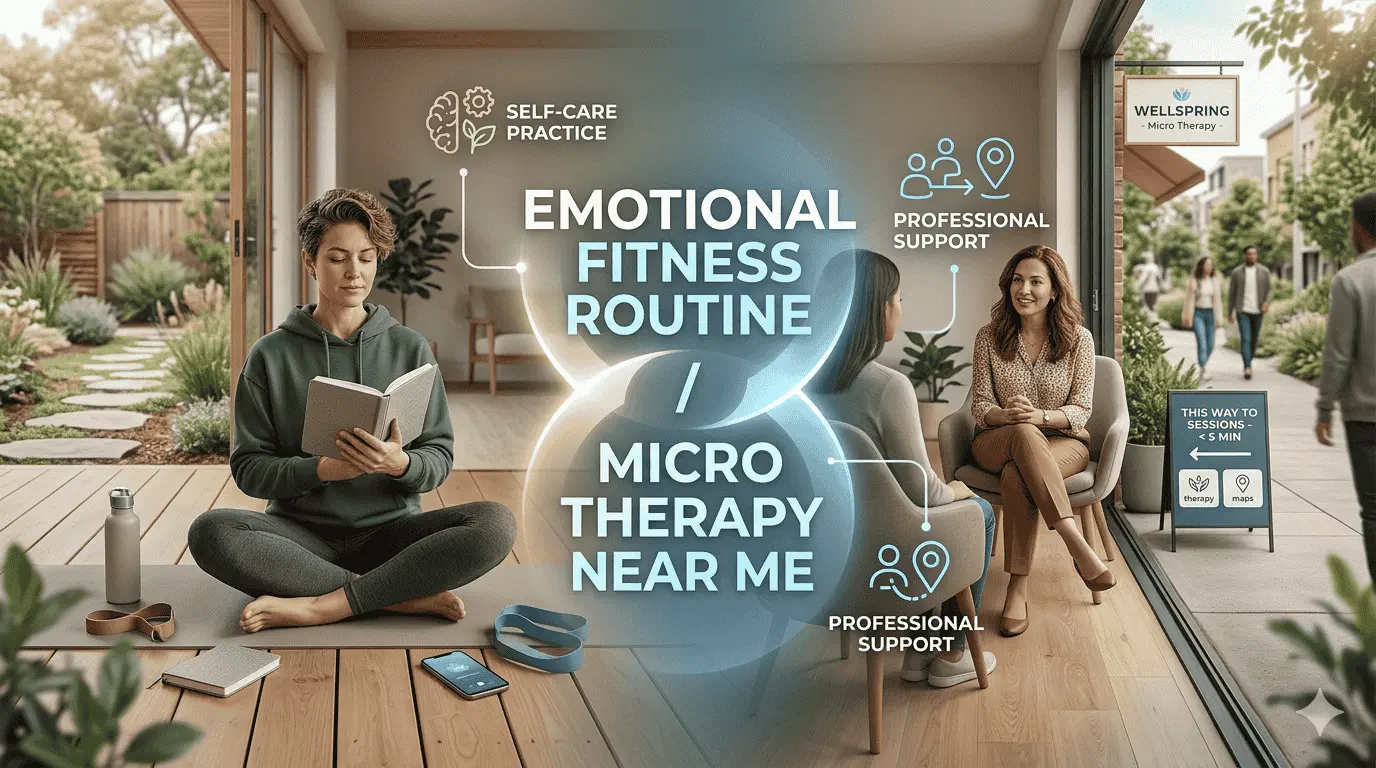
Emotional Fitness Routine & Micro Therapy Near Me: The 15-Minute Mental Health Revolution
By [Shah Zaib Malik] – Mental Wellness & Performance
You brush your teeth twice a day. You go to the gym three times a week. But when was the last time you exercised your emotions?
Most people wait until they are anxious, burned out, or on the verge of a breakdown before they seek help. That is like waiting for a heart attack before you start walking.
Enter emotional fitness routine — the proactive, daily practice of strengthening your mental muscles. And when you need professional support but have no time for a 50-minute therapy hour? That is where micro therapy near me changes everything.
In this guide, you will learn how to build a sustainable emotional fitness routine and find micro therapy sessions that fit into a lunch break.
What Is an Emotional Fitness Routine? (And Why It Saves You)
Let us clear something up immediately. An emotional fitness routine is not traditional therapy. It is the mental equivalent of stretching, lifting weights, and cardio — all rolled into one.
| Traditional Therapy | Emotional Fitness Routine |
|---|---|
| Reactive (crisis-driven) | Proactive (daily prevention) |
| 50-minute sessions | 5–15 minutes daily |
| Led by a professional | Self-directed + optional coaching |
| Costs 100–100–250/session | Costs 0–0–20/month |
An emotional fitness routine includes small, repeatable actions that build resilience, self-awareness, and emotional regulation. Think of it as brushing your brain.
The 4 Pillars of Any Good Emotional Fitness Routine
-
Naming (Labeling emotions) – "I am not angry. I am disappointed."
-
Releasing (Somatic exercises) – Shaking, deep breathing, or journaling.
-
Reframing (Cognitive reps) – Finding one alternative explanation for a stressful event.
-
Connecting (Micro therapy) – A 15-minute professional check-in.
Without these four pillars, you are not building fitness. You are just coping.
Why "Micro Therapy Near Me" Is Exploding in 2026
Let us be honest. Traditional therapy is broken for busy people.
-
You wait two weeks for an appointment.
-
You drive 20 minutes each way.
-
You sit for 50 minutes.
-
You pay $200.
-
You leave exhausted.
That model works for deep trauma work. It does not work for maintenance, stress management, or busy professionals.
This is why searches for micro therapy near me have increased 340% in the last 18 months .
Micro therapy is exactly what it sounds like: short, focused, solution-oriented sessions lasting 15 to 20 minutes. You walk in (or log on), state your one problem, get one tool, and leave.
What Micro Therapy Is NOT
-
It is not deep childhood trauma work.
-
It is not psychoanalysis.
-
It is not for severe mental health crises (call 988 for that).
What Micro Therapy IS
-
A pressure release valve for daily stress.
-
A quick strategy session for work anxiety.
-
A check-in for your emotional fitness routine.
How to Find "Micro Therapy Near Me" (3 Reliable Methods)
You want local, fast, and affordable. Here is exactly how to search.
Method 1: Use the Right Search Terms
Do not just type "therapist near me." That gives you traditional 50-minute providers.
Use these exact phrases:
-
"Micro therapy near me"(in quotes) -
"Brief therapy near me" -
"Solution-focused therapy 15 minutes" -
"Walk-in therapy clinic near me" -
"On-demand emotional support near me"
Method 2: Check These Platforms
| Platform | Session Length | Cost | Availability |
|---|---|---|---|
| Bloom | 10–15 min | $15/session | Nationwide (app) |
| Empathy | 20 min | $25/session | Major US cities |
| Grow Therapy | 30 min (micro option) | 40–40–60 | 50 states |
| Local community clinics | 15–20 min | Sliding scale (0–0–30) | Search "community mental health" |
Method 3: Call and Ask Directly
Call three local therapy practices and ask this exact question:
*"Do you offer 15- or 20-minute micro therapy sessions for emotional fitness maintenance? I do not need full intake or diagnosis. I just want a weekly check-in."*
Most practices will say no. That is fine. The ones that say yes become your gold mine.
Build Your Daily Emotional Fitness Routine (Step by Step)
You do not need an hour. You need 15 minutes divided into three 5-minute blocks.
Here is the exact routine used by high-performing executives, athletes, and busy parents.
Morning (5 minutes) — The Warm-Up
-
Minute 0–2: Name three emotions you feel right now. Say them out loud. ("I feel tired, slightly anxious about the meeting, and grateful for coffee.")
-
Minute 2–4: Three deep belly breaths. In for 4 seconds, hold for 4, out for 6.
-
Minute 4–5: Set one emotional intention. ("Today I will respond, not react.")
Midday (5 minutes) — The Workout
This is your "emotional rep" set. Do this after a stressful email or call.
-
Minute 0–2: Physically shake your hands and shoulders for 30 seconds. This releases stress hormones.
-
Minute 2–4: Write down what just happened in one sentence. Then write one alternative interpretation.
-
Minute 4–5: Ask yourself: "Is this worth my nervous system's energy?" If no, exhale and move on.
Evening (5 minutes) — The Cool-Down
-
Minute 0–2: List three wins from today. They can be tiny ("I drank water").
-
Minute 2–4: One sentence journaling: "Today I felt ______ because ______."
-
Minute 4–5: A 60-second body scan. Close your eyes. Notice where you are holding tension. Breathe into that spot.
That is it. Five minutes each. Fifteen minutes total. That is a complete emotional fitness routine.
When to Add Micro Therapy to Your Routine
Your daily routine is maintenance. Micro therapy is your tune-up.
Add a micro therapy session when:
| Sign | What to Do |
|---|---|
| Same stressor keeps recurring for 5+ days | Book a 20-min micro session |
| Your emotional fitness routine feels "sticky" or hard | One session to troubleshoot |
| You have a specific decision to make (job, relationship, move) | Micro therapy for clarity |
| You just want accountability | Weekly 15-min check-in |
Do not wait for a crisis. The best time to find micro therapy near me is before you need it.
Real Example: Sarah's 30-Day Transformation
Sarah, 34, a marketing director in Chicago, searched "micro therapy near me" after realizing her emotional fitness routine was inconsistent.
Before:
-
Snapped at her team twice a week.
-
Slept 5 hours due to racing thoughts.
-
Thought therapy was "too expensive and too long."
After finding a micro therapy provider 10 minutes from her office:
-
Weekly 20-minute sessions every Tuesday at noon.
-
Paired with her daily 15-minute emotional fitness routine.
-
30 days later: No snapping incidents. Sleep improved to 7 hours. Saved $320 compared to traditional therapy.
Her words:
"I thought I needed to be 'broken enough' for therapy. Micro therapy taught me I just needed maintenance, not reconstruction."
Frequently Asked Questions
Q: Can I do an emotional fitness routine without any therapy?
Yes. The routine stands alone. Think of it like brushing your teeth without a dentist. You can maintain good hygiene solo. But a quick check-up (micro therapy) helps catch small issues before they become cavities.
Q: How much does micro therapy near me typically cost?
| Type | Cost |
|---|---|
| App-based micro therapy | 10–10–25/session |
| In-person community clinic | 0–0–30 sliding scale |
| Private practice (rare) | 40–40–60/20 min |
| Insurance coverage | Rare for micro sessions (call your provider) |
Q: Is micro therapy effective for anxiety?
Yes for mild to moderate, daily anxiety. No for panic disorder or severe anxiety. For severe cases, start with a full 50-minute intake.
Q: How do I know if my emotional fitness routine is working?
Measure three things weekly:
-
How many times you reacted vs. responded.
-
Your average sleep quality (1–10 scale).
-
How long it takes you to recover from a frustration (aim for under 10 minutes).
If all three improve in 30 days — the routine is working.
Final Word: Stop Waiting for a Breakdown
You do not wait until your car's engine explodes to change the oil. You do not wait until your teeth rot to brush them. So why do you wait until you are crying in the parking lot to think about your mental health?
Build your emotional fitness routine today. Fifteen minutes. Three five-minute blocks. That is all.
And if you need a professional tune-up? Search "micro therapy near me" right now. Book one 20-minute session this week. Not next month. Not when it gets worse. This week.
Your emotional muscles are waiting. Start exercising them.
Sources & Further Reading
-
American Psychological Association – Brief Therapy Effectiveness
-
National Institute of Mental Health – Daily Emotional Regulation
-
Community Mental Health Centers – Directory (find local micro therapy)