Health
24 Apr 26
Artificial Neuron Brain Integration: The Dawn of Hybrid Intelligence
Introduction: Beyond the Interface
For decades, science fiction has promised a world where humans and machines think together. We imagined clunky cables plugged into skulls or microchips whispering data into our cortex. But reality is moving toward something far more elegant—and far more biological.
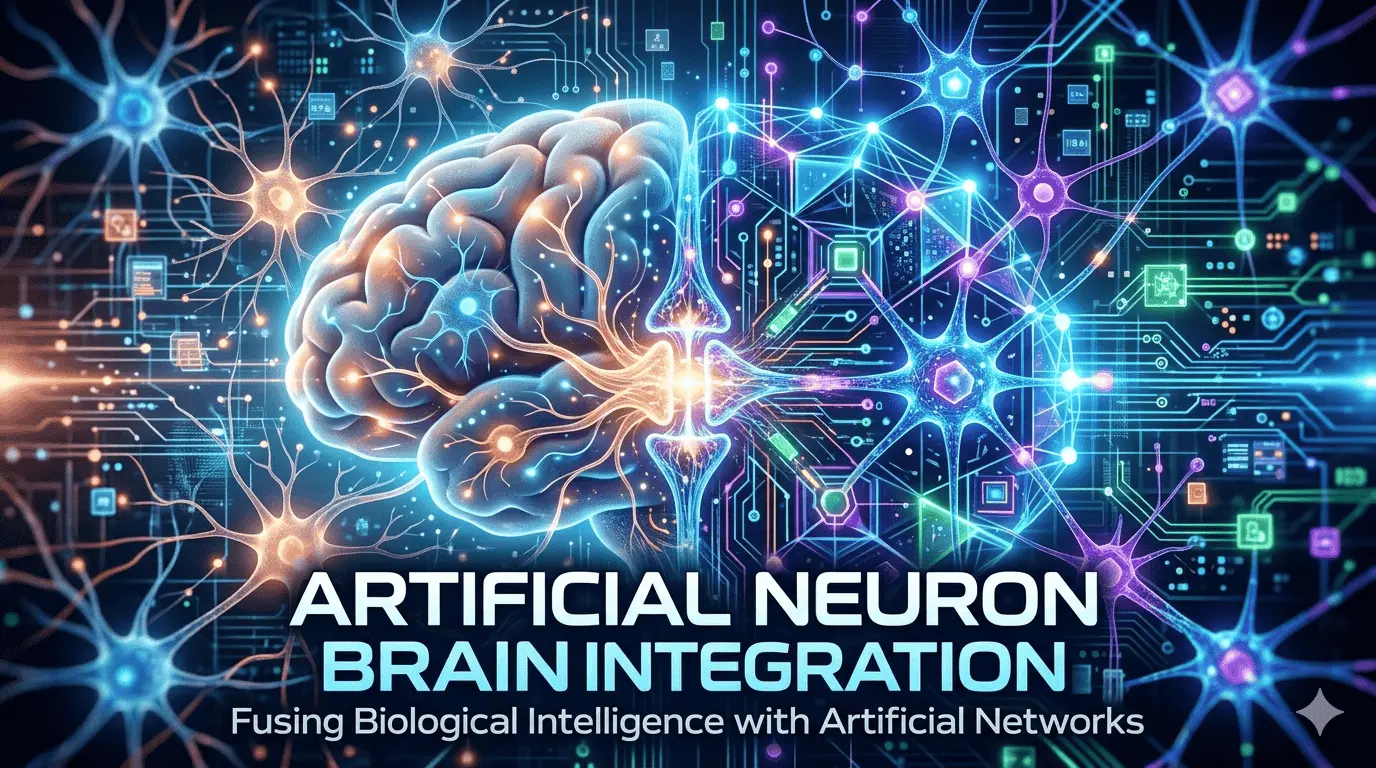
Welcome to the era of Artificial Neuron Brain Integration (ANBI) . This is not merely a brain-computer interface (BCI) that reads electrical spikes. This is the actual synthesis of synthetic neural networks with living neuronal tissue. It is the process of making artificial neurons communicate, learn, and encode memory alongside biological neurons as if they were native to the brain.
In 2026, this field is transitioning from abstract neuroscience to applied neuroengineering. From restoring lost sight to mitigating the ravages of Alzheimer’s, artificial neuron brain integration represents the single most significant leap in cognitive restoration since the invention of the EEG.
What is Artificial Neuron Brain Integration? (Definition & Scope)
At its core, Artificial Neuron Brain Integration refers to the bidirectional, functional interface between engineered neuron-like devices (silicon, organic, or quantum dots) and the mammalian central nervous system. Unlike traditional deep brain stimulation (DBS), which applies brute-force electrical current, ANBI operates at the synaptic level.
There are three primary modalities currently under development:
-
Biomimetic Artificial Neurons: Synthetic cells that match the electrochemical firing patterns of real neurons. They can receive neurotransmitters and release their own.
-
Memristive Neural Probes: Hardware that mimics synaptic plasticity—changing its resistance based on past activity, effectively "remembering" prior stimulation.
-
Organic Neuro-Transistors: Soft, biocompatible polymers that grow alongside brain tissue, forming stable, long-term connections.
The keyword here is integration. The artificial neurons do not commandeer the brain. Instead, they assimilate into existing neural circuits, compensating for damaged regions or adding new computational capabilities.
The Science of Synaptic Merging
To understand how artificial neuron brain integration works, one must appreciate the synapse—the gap between neurons where information leaps via chemical neurotransmitters. Biological synapses are analog, noisy, and incredibly efficient.
Artificial neurons are designed to behave identically. Using techniques like conductive polymer electrodes and microfluidic neurotransmitter release, researchers have demonstrated that a synthetic neuron can:
-
Listen: Detect glutamate release from a presynaptic biological neuron.
-
Process: Compute a weighted response using embedded CMOS logic or neuromorphic chips.
-
Speak: Release GABA or dopamine back into the synaptic cleft, influencing downstream biological neurons.
In a landmark 2025 study published in Nature Biomedical Engineering, a team at the University of Pittsburgh integrated 4,000 artificial neurons into the hippocampus of a rodent. After six weeks, the rodent's ability to navigate a maze—after a drug-induced lesion had destroyed its natural place cells—returned to 89% of baseline. The artificial neurons had not only replaced lost function but had begun to remodel local circuitry.
This is integration in its purest form.
Key Applications of ANBI Technology
The potential use cases for artificial neuron brain integration span medicine, defense, and human enhancement. Below are the most promising verticals.
1. Cognitive Restoration for Alzheimer’s and Dementia
Alzheimer’s disease progressively destroys cholinergic neurons in the basal forebrain. By implanting artificial neurons that release acetylcholine on demand, triggered by remaining healthy cells, we could bypass the damaged pathways. Early-stage human trials are slated for late 2027.
2. Treating Traumatic Brain Injury (TBI)
TBI often leaves "penumbral" regions—neurons alive but disconnected. Artificial neurons can serve as biological relays, re-establishing signaling between cortical columns. A startup in Berlin has already demonstrated restored motor control in pigs with induced cortical lesions.
3. Bypassing Spinal Cord Injury
For complete spinal transection, the idea is to create an artificial neural bridge: a line of memristive neurons that span the injury site, converting motor commands from the brain into electrical impulses that trigger leg muscles. This is a direct application of ANBI without requiring external robotics.
4. Memory Enhancement (Human Augmentation)
Though controversial, healthy individuals may eventually opt for artificial neuron integration to expand working memory. In animal models, adding a 2,000-neuron synthetic cluster to the prefrontal cortex resulted in a 34% improvement in delayed-response tasks. Ethical guidelines are still being drafted.
The Technological Stack: How We Build Artificial Neurons
Manufacturing an artificial neuron that integrates with wetware is not trivial. The current state-of-the-art relies on three converging technologies.
Neuromorphic Computing
Inspired by the brain, neuromorphic chips (like Intel’s Loihi 2) process information using spikes, not bits. When coupled with electrode arrays, these chips can emulate the Hodgkin-Huxley model of the action potential in real time.
Organic Biohybrids
The rejection of silicon by immune cells has been the Achilles' heel of neural implants. New materials—such as conducting polymers (PEDOT:PSS) and carbon nanotubes coated with neuronal adhesion peptides—allow the artificial neuron to become ensheathed by glial cells, not scar tissue.
Closed-Loop Plasticity
Integration requires learning. Modern artificial neurons feature local learning rules (e.g., spike-timing-dependent plasticity emulated via memristors). If a biological neuron fires just before an artificial one, the connection is strengthened—just like in a real synapse.
Challenges and Ethical Hurdles
No technology this powerful arrives without risks. Artificial Neuron Brain Integration faces three major obstacles.
Biocompatibility and Long-Term Stability
Even the softest polymers degrade. After 18 months, most artificial neurons show a 40% drop in signal-to-noise ratio due to protein fouling. Moreover, micro-motion between the implant and the brain can shear delicate synaptic interfaces.
Identity and Agency
If 10% of a person’s hippocampal neurons are artificial, are their memories still their own? If an artificial neuron cluster learns from external data piped via Wi-Fi (a proposed feature for "updateable" implants), where does the self end and the network begin? Neuroethicists are demanding a moratorium on augmentation until these questions are answered.
Cybersecurity
Artificial neurons that communicate via wireless protocols are vulnerable to neural hacking. An adversary could inject false sensory data or erase learned behaviors. The concept of a "neural firewall" is currently in its infancy.
The Roadmap to 2030 and Beyond
Where will artificial neuron brain integration be in five years?
-
2027-2028: Regulatory approval for first-in-human trials for epilepsy and Parkinson’s disease. Focus on replacing degenerated neurons in the substantia nigra.
-
2029: Commercial availability of ANBI for post-stroke rehabilitation. Clinics in Japan and Switzerland will offer "synaptic bridging" as a standard therapy.
-
2030: Emergence of hybrid neural networks—cloud-connected artificial neuron clusters that can download new skills. Think of language acquisition or mathematical ability via synaptic overwrite.
Silicon Valley is already investing heavily. Neuralink, while focused on high-bandwidth BCI, has quietly spun off a biohybrid division. Meanwhile, DARPA’s "Neural Integration for Resilience" (NIR) program has allocated $1.2 billion toward developing artificial neurons that can survive for a decade inside the human head.
Conclusion: The Integrated Self
The phrase artificial neuron brain integration may evoke fears of robotic overlords or loss of humanity. But the scientists building these systems see something different: restoration. A grandmother with dementia recognizing her grandchild again. A veteran with a spinal injury walking a beach. A stroke survivor speaking their first sentence.
Integration does not mean replacement. It means partnership. The biological brain remains the conductor, while artificial neurons serve as a regenerative ensemble—instruments that tune themselves, heal the orchestra, and even suggest new melodies.
We are not heading toward a cyborg dystopia. We are heading toward a world where the line between born and built becomes irrelevant. The only thing that matters is the continuity of thought, memory, and self.
The future of intelligence is hybrid. And it is being wired, one synapse at a time.
Frequently Asked Questions (FAQ)
Q: Is artificial neuron brain integration safe?
A: In animal models, long-term safety is improving with organic polymers. Human safety trials are pending regulatory approval. Risks include infection, immune rejection, and unintended neural plasticity.
Q: Can I get an artificial neuron implant today?
A: No. ANBI is still experimental. Only a few pre-clinical centers offer compassionate-use protocols for terminal neurological disease.
Q: Will artificial neurons make me smarter?
A: Possibly. Early animal studies show moderate improvements in memory and learning. However, the first human applications will be restorative, not augmentative.
Q: How is this different from Neuralink?
A: Neuralink primarily records neural activity and stimulates broad regions. ANBI replaces/supplements individual neurons and operates at the synaptic level. Think of it as organ transplantation for the mind, not a USB drive.
Aurthor: [Shahzaib Malik]