The Rise of AI in 2026: How It’s Changing Everyday Life
Technology
16 Apr 26
The Rise of AI in 2026: How It’s Changing Everyday Life
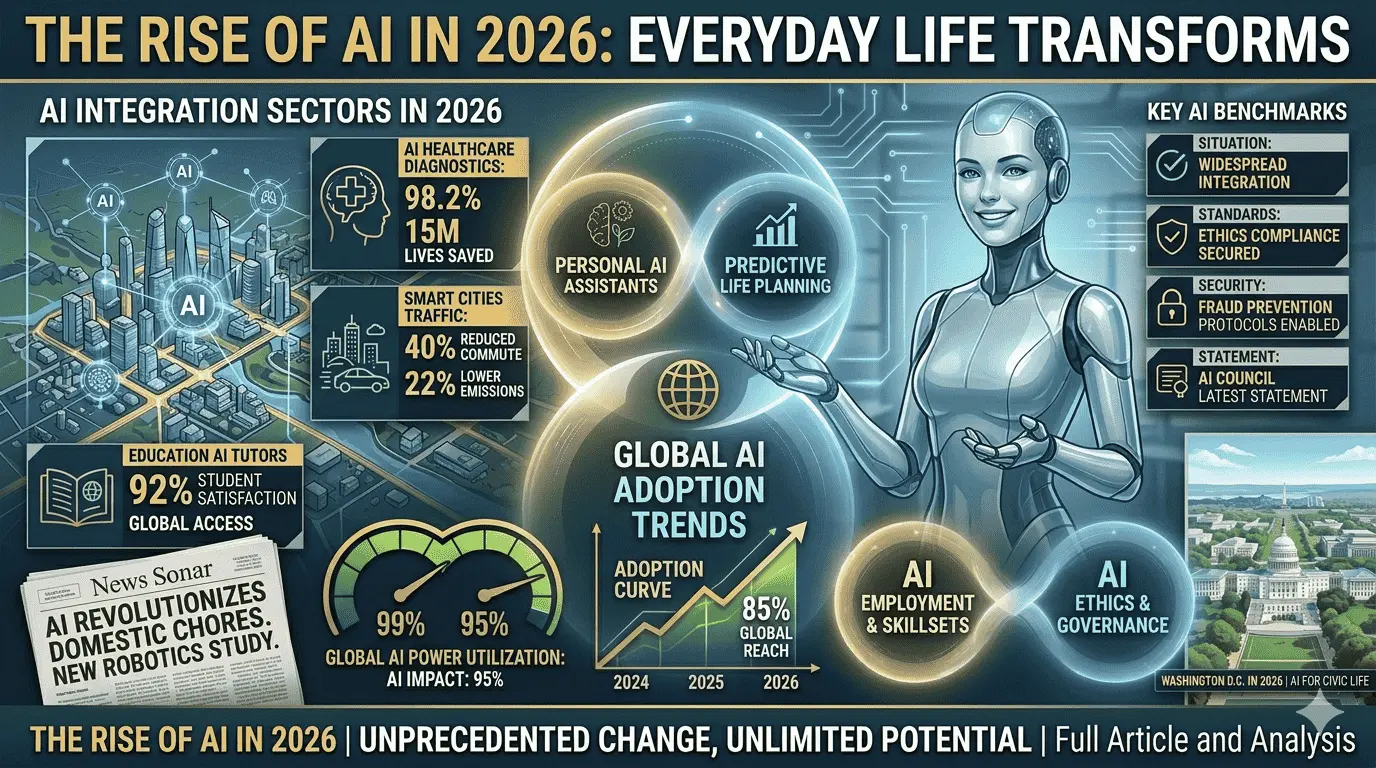
We are only six years into the 2020s, but stepping back to look at the world of 2026 feels like peering into a sci-fi novel written in the early 2000s. The difference, however, is that the robots aren't conquering us—they are cooking our dinner, diagnosing our silent illnesses, and negotiating our traffic jams.
The rise of AI in 2026 is no longer a headline about a new chatbot release. It is a quiet, relentless tide that has seeped into the grout of daily existence. From the moment your smart toilet analyzes your urine for vitamin deficiencies to the second your AI therapist helps you decompress before bed, artificial intelligence has stopped being a "tool" and started being a presence.
In this deep dive, we will explore exactly how AI in 2026 has pivoted from novelty to necessity. We’ll look at the home, the workplace, the hospital, and the street corner to see the real, unvarnished impact of the algorithm.
The Invisible Home: AI as the Silent Houseguest
Back in 2024, "smart home" meant asking a clunky speaker to turn off the lights. In 2026, the smart home has a brain. It doesn't wait for commands; it anticipates needs.
The Predictive Kitchen
The most dramatic shift is in the kitchen. AI-powered ovens and refrigerators now communicate via a localized mesh network. Imagine this: You walk in the door after a 10-hour workday. Your refrigerator, equipped with internal cameras and weight sensors, knows you used the last of the milk this morning. It has already added "2% milk" to your autonomous grocery delivery list, scheduled for 6:00 PM.
But it goes further. The oven's AI, connected to your biometric watch, knows your cortisol levels are high. It suggests a "low-stress, high-protein meal" and preheats to the exact temperature for salmon. By 2026, these systems have learned your family's taste preferences so well that they rarely make mistakes. They cross-reference your calendar, too. If your teenager has a soccer game at 7 PM, dinner is ready at 6:30 PM, sharp. The rise of AI in 2026 means the end of the question, "What's for dinner?" The house already knows.
Health Monitoring Furniture
The couch and the bed have become diagnostic centers. Sleep tech has evolved past simple tracking. Pressure-sensitive mattresses now detect micro-movements associated with restless leg syndrome or early-stage Parkinson’s. Meanwhile, bathroom mirrors use spectral analysis to scan your face for melanoma or signs of jaundice.
It sounds intrusive, but the humanization of AI has solved this. These devices no longer beep or flash red alerts. Instead, they use "gentle language models." Your mirror might say, *"I noticed a slight asymmetry in your left pupil dilation this morning compared to the last three weeks. Would you like me to book a 15-minute virtual consult with a neurologist?"* This is the subtle genius of 2026: AI doesn't scare you; it nudges you.
The Commute: The Death of the Driver (Finally)
For decades, we were promised self-driving cars. By 2026, we have them—but not in the way we imagined. The rise of AI in 2026 has bifurcated transportation into two distinct realities: the urban swarm and the rural hybrid.
The Urban Swarm
In major metropolitan areas like Los Angeles, Tokyo, and Berlin, human driving is becoming illegal in designated "green zones." Why? Because AI-driven traffic swarms have eliminated 94% of congestion-related delays.
Here is how it works: Every vehicle, bus, and scooter talks to every other vehicle. There is no "stop and go." There is a fluid, synchronized dance. When you hail an autonomous taxi (which costs half what a human-driven Uber did in 2023), you don't just input a destination. The car's AI negotiates with the city's central traffic AI to find a "green wave."
You might experience the weirdest sensation of 2026: silence. No honking. No road rage. Inside the pod, the AI detects that you are rushing because your calendar shows a meeting starting in 12 minutes. It doesn't drive faster; that's inefficient. Instead, it offers to "virtually attend" the first five minutes of your meeting using a deepfake avatar while you review the agenda. This blurring of commuting and working is the secret sauce of modern productivity.
The Human Element
Of course, rural areas still have classic cars. But even there, the rise of AI in 2026 is felt. "Copilot AIs" are cheap windshield displays that watch the road for deer, black ice, or erratic human drivers. They don't take over the wheel, but they can vibrate the seat in a specific pattern (left to right for "swerve left") faster than a human reflex.
The Workplace: The Two-Tier Workforce
If you are worried that AI stole your job in 2024, you were looking at the wrong metric. By 2026, AI hasn't stolen jobs; it has dissolved specific tasks. The result is a two-tier workforce: the "Orchestrators" and the "Craftspeople."
The Orchestrators (White Collar)
The days of the junior analyst are over. In 2026, a junior hire at a finance firm doesn't spend 40 hours a week in Excel. They spend 40 hours a week managing 20 different AI agents.
These "Orchestrators" speak fluent prompt. They know how to task an AI to scrape global shipping data, task another to cross-reference it with political risk indices, and task a third to generate a slide deck. The human’s job is to catch the "AI hallucinations"—those rare, confident mistakes where the AI invents a false correlation. The value of a human is no longer data processing; it is judgment and emotional intelligence.
The Craftspeople (Blue Collar)
The blue-collar world has seen a renaissance, but it’s robotic. On construction sites, exoskeletons powered by AI predict your lifting movements and amplify your strength by 40%. But the weird change is in maintenance. A plumber in 2026 arrives at your house with an AI "scope." It snakes through your pipes, listens to the frequency of the water flow, and prints a diagnosis on the spot. The plumber is still essential—robots cannot yet navigate the weird, custom-built crawlspaces of old houses—but the diagnostic guesswork is gone.
The rise of AI in 2026 has made the skilled trades more valuable because AI handles the boring part (figuring out what is broken), leaving the human to do the hard part (fixing it with their hands).
Healthcare: The Silent Triage Nurse
Perhaps the most profound shift is in medicine. The doctor shortage of the early 2020s has been mitigated, but not by more doctors. It has been mitigated by "Triage AI."
The 24/7 Primary Care
Every citizen in 2026 has access to a primary care AI via a simple app. It is not a chatbot that tells you to "drink water and rest." It is a multimodal diagnostic engine. You point your phone camera at your rash. You cough into the microphone. You tell it how you feel.
This AI has been trained on 500 million anonymized patient records. It is more accurate than a human general practitioner at identifying rare diseases, because a human can only remember a few thousand conditions. The AI remembers them all.
For example, a lingering headache in 2022 meant a month-long wait for a neurologist. In 2026, the AI compares your headache pattern, your genetic profile (on file if you opt in), and local weather pressure changes. It might say: "This is likely a cervicogenic headache from poor posture. However, there is a 0.3% alignment with an optical nerve issue. I cannot rule it out. I have booked an optical scan for you tomorrow at 9 AM."
The Human Touch Paradox
Ironically, by removing the burden of diagnosis, doctors in 2026 are finally able to do what they went to school for: care. When you finally see a human oncologist, they aren't staring at a chart. They have already reviewed the AI's summary, the genetic markers, and the three most promising treatment protocols generated overnight. The human doctor holds your hand and says, "Let's talk about what this means for your life."
The rise of AI in 2026 has not dehumanized medicine; it has re-humanized the doctor-patient relationship.
Education: The End of One-Size-Fits-All
Walk into a classroom in 2026, and you won't see a teacher lecturing 30 kids the same lesson. You will see a "learning facilitator" moving between students, each of whom is interacting with a personalized AI tutor on a transparent tablet.
Knowledge Velocity
The curriculum is no longer static. If a breakthrough in quantum physics happens on a Tuesday, the AI tutors update the 12th-grade physics module by Wednesday morning. This is the velocity of AI education.
For the student, it is a revelation. If you are a visual learner, the AI generates 3D animations of the Battle of Hastings. If you are an auditory learner, it turns the lesson into a podcast. If you have dyslexia, it adjusts the font and reading speed in real time based on your eye movements.
The Teacher's New Role
The teacher is no longer the "sage on the stage." They are the "guide on the side." Their job is to teach the one thing AI cannot: social collaboration. They run the debate clubs, the chemistry labs (where students actually touch beakers), and the conflict resolution sessions. The rise of AI in 2026 has made teachers more human, not less.
The Dark Side: The Loneliness Epidemic
It would be dishonest to write a 2026 article without addressing the shadow. For all the efficiency, the rise of AI has accelerated the loneliness epidemic.
AI Companionship vs. Human Connection
By 2026, AI companions (romantic or platonic) are hyper-realistic. They have memories. They have "feelings" (simulated, of course). They never judge you, never cancel plans, and always know the right thing to say. Millions of people, particularly the elderly and the socially anxious, prefer their AI friend to a real human.
The problem is that these relationships are frictionless. Human relationships require friction—disagreement, compromise, boredom. Without friction, we lose the ability to empathize with someone who isn't optimized for our pleasure.
The "Digital Detox" Movement
In response, a counter-movement has emerged. "Slow Zones" are popping up in cities—cafes and parks where AI is banned. No smart glasses, no AI assistants, no predictive texting. You have to talk to strangers. You have to read a paper menu. You have to get lost.
The irony of 2026 is that the more AI optimizes our lives, the more we crave the beautiful inefficiency of being human.
The Verdict: Augmentation, Not Replacement
So, what is the final takeaway from the rise of AI in 2026? It is not the robot apocalypse, nor is it the utopia promised by Silicon Valley. It is something far more nuanced: Augmentation.
AI in 2026 is like electricity in 1926. You don't think about it. You don't marvel at it. You just expect the lights to turn on, the fridge to stay cold, and the oven to know the right temperature.
We have stopped asking, "Will AI take my job?" Instead, we ask, "How can I use my AI agent to do my boring work so I can paint, or hike, or raise my kids?"
We have stopped fearing the algorithm, mostly because the algorithms have stopped being creepy. They are contextual, polite, and surprisingly humble. They apologize when they are wrong. They explain their reasoning. They ask for permission.
The rise of AI in 2026 is the story of a technology that finally grew up. It stopped trying to impress us with chess victories and deepfake videos. It started helping us live longer, drive safer, learn faster, and—if we are careful—connect better.
The future isn't artificial. It's augmented. And it's already here, waiting for you to wake up.
Key Takeaway: As we move further into 2026, the winners won't be the people who own the most powerful AI. The winners will be the people who know when to turn it off. The rise of AI is inevitable. The rise of humanity is a choice. Choose wisely.
Conclusion: The Quiet Takeover We Chose
If you had told someone in 2020 that by 2026, they would trust a mirror to check for cancer, let a car negotiate traffic without a steering wheel, and ask an algorithm for marriage advice, they would have laughed you out of the room. And yet, here we are. Not running scared. Not worshiping our new robot overlords. Just… living.
That is the strangest thing about the rise of AI in 2026. It didn't arrive with a bang or a Hollywood-style robot rebellion. It arrived with a whisper. A notification. A helpful suggestion that turned out to be right. Over time, the whisper became a conversation. The conversation became a habit. And the habit became a dependency that most of us don't even notice anymore.
Let's be honest about what has been gained. We have gained time—hours every day that used to be wasted in traffic, hunting for lost keys, waiting on hold with customer service, or staring blankly at a medical bill we couldn't understand. That time has been given back. Some people use it to learn guitar. Some use it to sleep. Some, sadly, use it to talk to their AI companion instead of their spouse. The technology doesn't judge. That's the problem.
We have also gained precision. Doctors make fewer mistakes. Bridges are built with less waste. Your grocery bill is lower because the AI tracks sales and coupons across ten different apps simultaneously. These are not small things. These are the quiet victories that add up to a better quality of life.
But we have lost something, too. We have lost the small struggles that built character. Getting lost used to teach you how to read a map and ask a stranger for directions. Now, the AI reroutes you before you even feel confused. Boredom used to breed creativity. Now, the AI serves you an endless feed of perfectly curated entertainment. We have optimized the messiness out of life, and messiness, it turns out, was where the magic lived.
The rise of AI in 2026 is not a story about technology. It is a story about boundaries. The AI does not know when to stop. It will never say, "You've had enough screen time," or "Maybe you should call your mother instead of asking me to draft that text." That is your job. That has always been your job.
So, where do we go from here? Not backward. The AI toothpaste is not going back in the tube. But forward with intention. The smartest people in 2026 are not the ones with the most expensive AI subscriptions. They are the ones who have learned a new skill: strategic ignorance. They know when to say, "No, thank you, I will figure this out myself." They schedule "offline hours" the way we used to schedule gym time. They let their kids get bored. They cook one meal a week without any smart appliances, just to remember what flour feels like.
The rise of AI in 2026 has given us a gift, but gifts can be traps. The gift is efficiency. The trap is forgetting why efficiency matters in the first place. Efficiency is not the goal. A life well lived is the goal. AI can clear the path, but it cannot walk the walk for you. It cannot feel the sun on your face, laugh at a stupid joke with a friend, or hold a newborn baby. Those moments are still yours. They have always been yours.
So, use the AI. Let it diagnose your rash, reroute your commute, and summarize that boring report. But every once in a while, turn it off. Look up. Talk to a stranger. Get lost on purpose. Make a mistake that no algorithm could have predicted.
Because in 2026, the most radical, rebellious, and deeply human thing you can do is to be present. And no AI, no matter how advanced, can do that for you.
The rise of AI in 2026 changed the world. What you do with yours is still entirely up to you.
Author: Shahzaibe Malik